
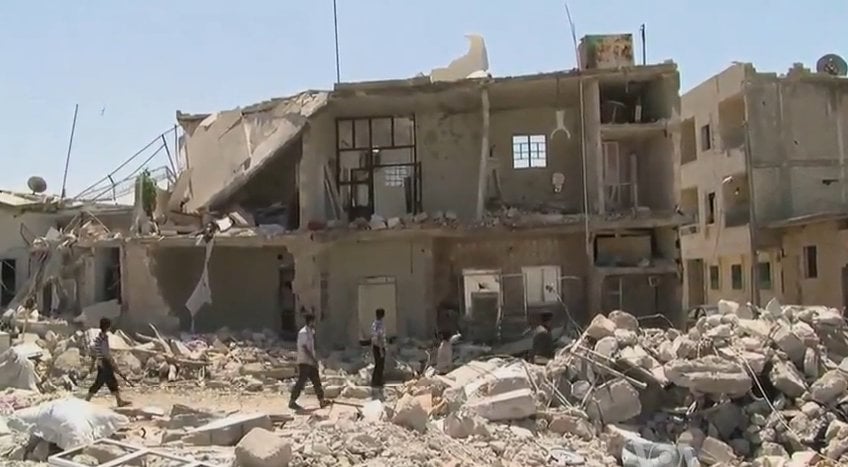
In the spring of 2011, sparked by the Arab Spring, the Syrian people revolted against the regime of its President, Bashar al-Asad. The protests were violently crushed by the government, and in the fall of 2011 the Free Syrian Army was created to provide armed support to the uprising. From 2012 onward, the conflict developed into a long-running sectarian civil war, with the international community providing military support to both parties. Gradually, terrorist organizations like ISIS and Jabhat al-Nusra became involved in the armed conflict as well. From the start of the conflict, a total number of approximately 280 Dutch nationals have travelled to Syria.
Various cases have been brought to Court in the Netherlands regarding international crimes committed during the Syrian civil war; this concerned cases against members of terrorist organizations, armed opposition members, pro-regime militias and Dutch foreign terrorist fighters.
Case against Xaviera S.
During the criminal investigation, according to the Public Prosecution Service it became clear that joing ISIL was not the only criminal offence she needed to be held accountable for. By moving into houses of Syrian citizens who were chased from their homes by ISIL, by using furniture and other personal items that the original residents had left behind, and by taking such items with her when moving to a next house, S. was guilty of the war crime of pillaging, according to the prosecutors. On 26 April 2024, The Hague District Court ruled differently: there was insufficient evidence that the houses had been obtained illegally and that S. had contributed to this. The Court therefore acquitted S. for the war crime of pillaging.
S. was convicted for membership of a terrorist organization, as well as for threats she had made online towards two Dutch journalists. The Hague District Court convicted her to 860 days in prison. Due to the time S. had already spent imprisoned in Türkiye and the intensive treatment she underwent in the Netherlands, a substantial part of her prison sentence (i.e. 720 days) was suspended. For threatening the two journalists, the Court convicted S. – in addition to her prison sentence – also to 480 hours of community service. Claims for compensation made by the two journalists were declared inadmissible by the Court.
Because of the acquittal for the war crime of pillaging, and the declaration of inadmissibility of the journalists’ claims for compensation, the Public Prosecution Service has appealed the Court’s verdict.
Judgment:
The Hague District Court, 26 April 2024 (ECLI:NL:RBDHA:2024:6009)
Case against Krista van T.
The Public Prosecution Service was convinced, however, that Van T. was to be held accountable for more than just that. By moving into various houses that were captured by ISIL from their opponents – i.e. ‘infidels’, Syrian citizens, presumably fled or killed – Van T. was guilty of pillaging. A contribution to the terrorist domination by ISIL, according to the prosecutors, and a war crime. The prosecutors also blamed Van T. for taking her young children to the ISIL territory, where they were frequently faced with extreme violence and ISIL propaganda. By doing so, she put them in a helpless state; a criminal offence.
On 26 April 2024, The Hague District Court convicted Van T. to 48 months in prison (of which 12 suspended) for membership of a terrorist organization, and for putting her children in a helpless state. Van T. was acquitted of the war crime of pillaging, because according to the Court there was insufficient evidence that the houses had been obtained illegally and that Van T. had personally contributed to this.
Judgment:
The Hague District Court, 26 April 2024 (ECLI:NL:RBDHA:2024:6256)
Case against H. al-S.
After an extensive criminal investigation, according to the Public Prosecution Service there was enough evidence for the brigade’s involvement in the large-scale pillaging of vehicles along the Aleppo-Damascus highway, which ran through Khan Shaykhun. This created a situation of uncertainty and insecurity for the local population, that was already dealing with the harsh conditions of a protracted civil war. The brigade therefore needed to be qualified as a criminal organization with the aim of committing war crimes, according to the prosecutors. For being a member of that criminal organization, Al-S. was to be convicted to an unconditional prison sentence.
Shortly before the Court’s examination of the case was closed, circumstances caused the examining judge to advise the Court not to use certain parts of the evidence, because their reliability could no longer be guaranteed. Following this development, the Public Prosecution Service asked the Court for a full acquittal. On 26 April 2024, Al-S. was acquitted by The Hague District Court.
Judgment:
The Hague District Court, 26 April 2024 (ECLI:NL:RBDHA:2024:6011)
Case against Mustafa A.
Based on an expert report about Liwa al-Quds, the Public Prosecution Service concluded that the militia ought to be qualified as a criminal organization with the purpose to commit international crimes. Furthermore, the investigation team receives an report by an NGO, containing several statements by witnesses claiming that A. was directly and personally involved in the violent arrest of two civilians. Both civilians were then handed over to the Syrian Air Force Intelligence Directorate, in whose detention facilities they were subjected to torture. After extensive investigation by the International Crimes Team and the National Office of the Netherlands Public Prosecution Service, A. was arrested on 24 May 2022 in Kerkrade, the Netherlands.
On 22 January 2024 the Hague District Court ruled that Liwa al-Quds was indeed a criminal organization whose purpose was to commit both bodily harm and pillage as war crimes, and deprivation of physical liberty as a crime against humanity. The Court also confirmed that Mustafa A. had had a leading role within the organization. Furthermore, the Court judged that A. was criminally involved in the arrest of one of the victims, and complicit to the torture that the victim had been subjected to in detention. Due to lack of sufficient evidence, A. was acquitted for his alleged involvement in the arrest and torture of the other victim. The Court sentenced him to 12 years in prison.
Both A. and the Prosecution Service have appealed the Court's decision.
Judgment:
Case against Ahmad al-K.
The suspicion arose that the battalion of Al-K. was responsible for this war crime. On 21 May 2019 Al-K. was therefore arrested in the Dutch village of Kapelle, on suspicion of membership of a terrorist organization and committing a war crime. At a later stage in the investigation another video emerged; the video, shot from a different angle, clearly shows Al-K. present at the scene of the crime. It can be seen that he takes a leading role during the execution and that he fires his gun several times in the direction of the victim.
On 16 July 2021 the Hague District Court has judged that Al-K. was indeed criminally involved in the execution of a captured officer, a war crime. The Court also found, however, that there was insufficient evidence to conclude that Al-K.’s battalion was affiliated with Jabhat al Nusra, and therefore acquitted him on the count of membership of a terrorist organization. For his involvement in the execution, Al-K. was sentenced to 20 years in prison. Both Al-K. and the prosecution service have appealed against the decision.
On 14 November 2023 the Hague Court of Appeal upheld Al-K.'s acquittal for membership of Jabhat al Nusra. It ruled, however, that the battalion in which Al-K. fulfilled a leading position, could itself be qualified as a terrorist organization. Hence, Al-K.'s prison sentence was increased to 23 years and 6 months.
Judgment:
The Hague District Court, 16 July 2021
The Hague Court of Appeal, 14 November 2023 (ECLI:NL:GHDHA:2023:2191)
Case against Yousra L.
The Hague District Court, in its verdict of 29 June 2021, found Yousra L. guilty on all counts and sentenced her to 6 years in prison and detention under a hospital order including a compulsory psychiatric treatment. It was a unique verdict in two ways: firstly, it was the first time that somebody was convicted for committing a war crime from within the territory of The Netherlands. Secondly, for the first time the Court concluded that ISIS was not only a terrorist organization, but also a criminal organization with an aim to commit international core crimes. Yousra L. has appealed the Court's decision.
Judgment:
Case against Ahmad al-Y.
Al Y., while armed with an assault rifle, can furthermore be seen celebrating their deaths while referring to them as ‘dogs’. In the context of the Syrian armed conflict these acts constitute a war crime. On 22 October 2019 Ahmad al-Y. was arrested by the police. While Al-Y. was in custody, a second video emerged in which he is posing next to a captured adversary and is interrogating him in front of the camera together with other armed men.
On 21 April 2021 the Hague District Court has found Al-Y. guilty of membership of a terrorist organization and of committing a war crime. By putting his foot on a corpse, making a kicking movement to another and by celebrating the deaths of the deceased adversaries while referring to them as ‘dogs’, he has committed outrages upon their dignity. Although the Court found the second video humiliating and degrading, it found that this incident did not reach the threshold for being qualified as an outrage upon the victim’s dignity. Regarding this second video, Al-Y. was therefore acquitted. For the other facts, the Court sentenced him to a total of 6 years in prison. On 6 December 2022, however, the Hague Court of Appeal ruled that both videos did not reach the aforementioned threshold, and acquitted Al-Y. from all core international crimes he was charged with. His sentence was hence lowered to 5 years and 4 months. The prosecution has appealed in cassation at the Supreme Court.
Judgments:
Case against Oussama A.
At a certain point, the Dutch police gets hold of a picture circulating on social media. The picture shows A. as he stands – smiling – next to the crucified body of a man who was executed by ISIS. A. has disseminated the picture himself. Therefore, apart from membership of a terrorist organization, A. is also suspected of having committed a war crime. By posing next to a crucified body, while smiling, and subsequently disseminating that picture, A. has committed an outrage upon the personal dignity, in particular humiliating and degrading treatment, of a protected person. These flagrant and serious violations of human dignity are prohibited by common article 3 of the Geneva Conventions (implemented in the Netherlands by article 6(1)(c) of the International Crimes Act).
On 23 July 2019 the The Hague District Court has found A. guilty of membership of a terrorist organization, preparatory acts for committing terrorist crimes, and of the war crime of committing outrages upon personal dignity. The Court thus sentenced him to 7.5 years in prison, of which 2.5 years specifically for the war crime. On 26 January 2021 the The Hague Court of Appeal lowered the overall verdict to 7 years of imprisonment, but upheld the verdict with respect to the war crime (2.5 years in prison). A. has appealed in cassation at the Supreme Court.
Judgment: